Wednesday, May 12, 2010

Curtailment of Indic quest of power & its implications

The following is a video of the meet of Kalyan Rishi with Alexander, from the popular Chanakya serial aired on DoorDarshan (India's national channel)


As we heard, Kalyan Rishi warns Alexander about the futility of his warring and conquering nature, and tells him to conquer his mind instead. Another point the revered Rishi makes is that a state can be controlled with the head at the capital and not at the fringes of the state (w.r.t. Alexander's presence in NW India & not in Macedonia)

If the account of the meet expressed in the serial is true, then drawing an extrapolation of what the Rishi said can lead us to two thoughts prevalent at the time:

  1. Harnessing of ambitions of other people's territory was discouraged.
  2. Any ambition was curtailed and people were trained to control their natural urges.
Now, it is true that overt ambition can lead to a disaster. But some amount of ambition is required to get some things done. Besides, ambition coupled to a sustained chain of efforts has often lead to great achievements in the human society. A lukewarm ambition and a lukewarm approach to getting things done will only develop a status quo society, a society of moderate achievers and few spectacular achievements. Which approximately describes our condition today. We seemed to have taken the Rishi's preachings to the other extreme.

A specific quanta of ambition, a desire for success should be as inseparable as the five senses of the body. And as was said in the holy Gita about the sense organs: - "that they need to be controlled, not suppressed." So should be that quanta of ambition and desire for success.

Because of our emphasis on controlling desires and not allowing the positive feedback loop of more and more ambition take root in at least limited sections of the society, while our civilization has lived long because of more energy spent in the basic necessities of living, we have a few unintended consequences:

  1. Once a territory of the nation was lost, and a constantly new national identity was created in the lost territory (ala Afghanistan and other reputed cases,) it has proved difficult to create the national fervour to get the territories back.
  2. With lust for power in others' territories stopped, and assuming that such lust for power is unavoidable by the ruling classes after a stretch of time, the only way to get more power was to grab it from fellow people. Could this be the reason for large amounts of infighting among Indian kings?
  3. Lack of sense of strategic importance of certain geographical locations. For instance, our inability to control entries from the Khyber pass vis-a-vis the Chinese creation of the Great Wall (although it failed in its immediate objective, but 10/10 for the effort).
  4. Lack of the above sense is also responsible for the inability to get diplomatic allies and India digging its lone furrow.
  5. Lack of extraordinary achievements in fields of sciences beyond certain blips of time.
Time to let loose a controlled quest of power so that we can rise above from being a status quoist power, and realise an India that not only we are content at looking up to, but our allies would love to befriend and our enemies would fear to face.

Sunday, February 7, 2010

Lost and Found Shivaji: A story

This post is from 2010 print edition of "Tattva - A hindu magazine for youth" on their 3rd anniversary. The story is about how Shivaji, after a discourse of Sadguru Tukaramji Maharaj leaves the path of a warrior and decides to go on the path of Bhakti yoga and become a devotee of Lord Ram. (With all credits to Sharath Kumar, a grad student at UT Dallas.)

People around him (Suryaraj and Jivamahal) are bewildered and get worried as to what would happen of Shivaji's newly founded kingdom if he renounces his duties like that. It took Tukaram Maharaj to persuade Shivaji to go back and take advice from Shree Samarth Ramdas who would better explain to Shivaji the path he should choose in life.

This is the excerpt when the conversation between Shree Samarth Ramdas and Shivaji starts:

"The ever compassionate Samartha Sadguru looked kindly at Shivaji Maharaj and said to him, "O Shivaba, I know what doubts assail you. What you saw at the Keerthan was indeed the infinite glory and splendor of Lord Rama, sung by Tukaram Maharaj, his great devotee. It is indeed this essence of truth and splendor that we are all striving to reach."

"There are many paths to this destination. Just like all paths up a mountain ultimately lead to the peak of the mountain, all paths lead to the same truth, the same essence of the universe."

http://www.sssbalavikas.org/imgs/glrsep001.gif

As Lord Vishnu, in his Krishna avatara (incarnation) has said in the Bhagavad Gita, there are four types of yoga: Jnana Yoga, Bhakthi Yoga, Karma Yoga and Raja Yoga. Each of these paths is as good as the other. But depending on one's inherent tendencies, which are a result of one's actions in this life and preceding lives, one gets attuned to follow a particular path. There is no path that is better than the other. One cannot argue that his path is better than another's path.

According to you tendencies in this life and in previous lives, you were born a warrior. It is this tendency, O Rajan (king), that made you take the oath of Swarajya ( a free land) when you were a mere stripling of a boy. It is this tendency that made you capture Torna fort when you were a mere teenager. If a person is standing on a cliff and sees nectar on another cliff separated from his cliff by a deep ravine, he may jump toward the nectar and end up falling in the ravine. Similarly, you are trying to jump from your chosen path of karma(duty) to the path of bhakthi (devotion)."

Shivaji Maharaj, who was listening attentively until now, spoke to the Sadguru, "But O Lord, why can't I become a haridaasa and chant the name of the Lord all the time? What is wrong with me, or what is wrong in choosing that path?"

The Samarth said, "Oh Shivaji, you are now enamored by the way of haridaasa. Let us assume that you do become one. It is of utmost importance that the heart and mind should be one hundred percent directed towards the worship of God. However should you hear that a temple is destroyed, should you hear of innocent people killed because they refused to convert, should you hear of women being abducted and their honor put to stake, would you still be calm? Would you still be able to see Pandurange? If those innocent and hapless women and the orphaned children of the Mughal tyranny start thinking, "If only Shivaji Maharaj had not renounced the world. Why did he do such a ghastly deed?", when you hear their cries and anguish, would you still be calm? Do you think you will be able to sing the glories of the Lord in peace?"

Shivaji Maharaj answered, "No, Guru Maharaj. I now realize that I cannot. But is there no way for me to glimpse the infinite glories of Lord Rama, which you have experienced? I know that I can by your grace. Kindly help me in this pursuit as well."

The Samarth replied, "Oh Shivaba, I see Lord Rama as clearly as I see you. There are various ways to reach him. I reached him by thinking of him and only him. All my actions were dedicated to him. I thought of him alone as the doer and myself merely as an instrument. When I gae up this false ego, I was able to see him and experience him. There was everlasting bliss. Having achieved his feet, what was there for me to do. Yet the Lord instructed me to spread his glory. As I was doing so, I saw the miserable conditions of the people of Sanathana Dharma. They groan under this foreign oppression. Hence I set about constructing temples of my Lord Shree Rama.

Take Mahavira (Lord Hanuman). How much was his surrender to the Lord? He did anything and everything for the sake of Lord Rama. He fearlessly flew to Lanka taking Shree Rama's name. He single-handedly combated the demons at Ashoka Vatika. He neither had fear nor cared for his life. All that mattered was service to Lord Rama. That was his duty.

Likewise, O Shivaba, do everything as a service to the Lord. Offer the results to Rama. You do your work. A grihastha (householder), who does his work with devotion and offers the fruits to the lotus feet of Lord Rama is as great, if not greater than a sanyasin (one who has renounced the world).

I accept you as my disciple. If you follow me as your guru, here is my advice to you. Let all your worries, doubts, and burdens be with me. Leave them to me, and thinking of me, do your dharma (duty) with sincerity and submit the fruits to Lord Rama. Then you shall reach the very same place, which Shree Tukaram Maharaj and I have reached. Do not have any doubts anymore. I will take you to the abode of Rama."

Thus dispelled of all fears and doubts, Shivaji Mahraj fell at the Lotus feet of the Samartha Sadguru and declared, " Oh Sadguru Maharaj. Your words are the Vedas for me. Now my mind is clear. I shall continue performing my duties, and offer the results at your lotus feet, O Maruthi (Hanuman) avatar. I am now fearless as I know that you shall guide me, and now no fear or doubt can assail me, since I am protected by your grace."

The Samarth Sadguru was pleased, and placing his right hand on the head of Shivaji Maharaj, he declared, "Go now Shivaba. Go to your favorite temple at Tuljapur. Go to Mother Bhavani. Pray to her earnestly for three days, and she will help you in the successful accomplishment of your duty."

Thus, Shivaji leaves for Tuljapur and prays to Mother Bhavani for three days. The Mother appears befor Shivaji and grants him her parashu (axe) and khadga (sword). With the discourse of Shree Samarth Ramdas Maharaj and boon from Ma Bhavani, Shivaji is now ready to take on the Mughals.

Moral: The successes that Shivaji had with the Mughals are well known. The story tells us that it was through Karmayoga that all of that was possible. Besides, as the Hindu nation reeks with follies such as this and this, while greater issues (and this of course) remain unresolved, one cannot help but wonder if the darkest of hours are upon us. As per the author, in these dark times, there are three lessons to learn from Shivaji's story.

1) The Hindus, even in the darkest of hours can overcome any obstacle.

2) With few resources too, the Hindus can make great achievements with confidence in their faith.

3) One individual can make a difference. It took just Shivaji to change the tide of history for the Hindu nation.


Sunday, January 24, 2010

Social Service: At the Bhaktivedanta Ashram.

It was always our constant endeavor to make the Gita relevant to modern life. This not only requires interpretation of the Gita as per today's age, but implementing it.
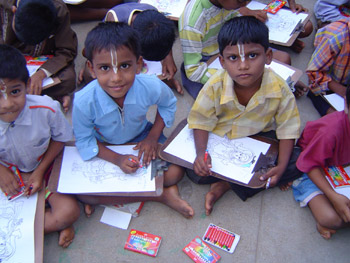
It turns out that a few people have put into practice parts of philosophies related to the Gita and other Hindu scriptures into practice. One such set of people have stood true to Rishi Kindamb's philosophy of the debts of life. Having attained literacy (equivalent of 'truth' in the hyperlinked post), these people are returning it to the society just as advised by Rishi Kindamb. While our certainty of aiding them remains doubtful, the least we can do is to catalog the list of societies/institutions that are linked to public service and welfare (without any expectations of conversions of course) so that we can do our bit in spreading awareness about them among people who are suitably placed in helping them.


In every branch of the Bhaktivedanta Ashram we give special focus to organizing programs for needy children living around our Ashrams. The programs contain a variety of activities, including school lessons, spiritual classes on the Bhagavad Gita, bhajans and kirtans, art classes, games and recreational activities. At the end of each program the children are fed a healthy and nutritious meal of prasadam (sanctified food offered to God).

Our first children's programs were begun in Orissa at our headquarters, where we had started an informal school for poor children from nearby areas around our Ashram. In a very short period of time around 150 children were attending this program each day. Many of these children would previously spend their time begging, rummaging through garbage piles, and doing other such activities. One by one we met with these children and spoke to them about the importance of their life and convinced them to change their lifestyle by taking interest in learning and spiritual activities.
Read more from the hyperlinked photograph.

Sunday, November 29, 2009

Revolution in Hinduism

It is said that we (Indians) as a race, can never rebel. Of course, rebelling is not the first thing that comes in the common man's mind, but there has to be a revolutionary, so this statement in a way applies to all of the human race in general. There have to be some people who put forth new ideas that instill in the people, a zeal for something new and the realization that what they were doing before is wrong.

The saying I mention in the beginning of the post is more reinforced on the outsider when they look at our current state. Rabid evangelicals spouting their foul propaganda, Maoists conducting their campaign, and scheming Islamists try to convert gullible natives to their fold one way of the other and yet knowledgeable Indians just lead their normal lives.

But Hindu history suggests that we were never so placid. In fact, we are a race which even brought arrogant Gods to their knees. The story of the lifting of the Govardhan mountain reveals this.


(link)Govardhan Puja is celebrated the day after Diwali. It is the day Lord Krishna defeated Indra, the deity of thunder and rain. As per the story, Krishna saw huge preparations for the annual offering to Lord Indra and questions his father Nanda about it. He debated with the villagers about what their 'dharma' truly was. They were farmers, they should do their duty and concentrate on farming and protection of their cattle. He continued to say that all human beings should merely do their 'karma', to the best of their ability and not pray or conduct sacrifices for natural phenomenon. The villagers were convinced by Krishna, and did not proceed with the special puja (prayer). Indra was then angered, and flooded the village. Krishna then lifted Mt Govardhan and held it up as protection to his people and cattle from the rain. Indra finally accepted defeat and recognized Krishna as supreme. This aspect of Krishna's life is mostly glossed over - but it actually set up on the basis of the 'karma' philosophy later detailed in the Bhagavat Gita.


It also represents the downfall of Indra, and a new beginning in Hindu philosophy, from a more sacrificial/ appeasement oriented worship, to a more spiritual plane of thought. This evolution of thought in Hinduism was brought about by Krishna, and therefore he has been the most important Hindu deity since then - considered an 'avatar' of the supreme. The more we look at his life story - we find him to be a great reformer of his time.


Centuries of imperialism have brought Indians back to the plane of thinking the worshippers of Indra were. All our policies are rooted in sacrifice and appeasement. Take for example, the Article 370 of Kashmir. Then comes the existence of the AIMPLB. The mere mention of it should be anathema to India that there is a parallel law in the country and hence possibly a parallel power centre? Yet it thrives and we continue to tolerate it.

More such examples abound the nation. While celebrating Govardhan Pooja, not only do we sing hymns which most of us do not understand, but the whole importance of Govardhan lifting incident is lost on us. Time we remember the spirit, and act on it in our own ways.

Saturday, October 17, 2009

Happy Deepavali!!

Wishing all of our readers a very Happy Deepavali and a prosperous New Year. Our sincere apologies for the more than ever sporadic posting these days but our professional life is taking a serious toll on our creative abilities. As of now, the best we can promise is merely one post per month.


But for today, an explanation from a personal blog about the story of the five days of Deepavali.
A brief excerpt is as follows:

On this Diwali day, we light lamps to commemorate the sacred memories of those great men who lived to brighten the lives of millions of their fellow beings:

● Lord Shri Krishna around whom revolved the entire story of our great epic Mahabharat and the philosopher, who preached Karmayog through his Geeta to Arjun on the battlefield of Kurukshetra, discarded his body.

● Bhagwan, Mahavir, the Jain prophet also attained nirvana on this day.

● Swami Ramtirth, the beloved "Ram Badshah" of millions of Indians was not only born on this day and took both sanyas and samadhi on this day.

● Swami Dayanand Saraswati, founder of Arya Samaj in 1875 in Mumbai, with his superb yogic powers freed his soul from his body and mingled with divinity on this auspicious day of Diwali.

Another very interesting story about this Diwali day is from the Kathopanishad. In this story, a small boy called Nachiketa believed that Yam, the god of Death was as black as the dark night of amavasya. But when he met Yam in person he was puzzled seeing Yam's calm countenance and dignified stature. Yam explained to Nachiketa on this Diwali day of amavasya that by only passing through the darkness of death, man sees the light of highest wisdom. It is only then only his soul can escape from the bondage of his mortal frame to mingle with the Supreme Power. It was then that Nachiketa realized the importance of worldly life and significance of death. All of Nachiketa's doubts were set to rest and he whole-heartedly participated in Diwali celebrations.

Sunday, October 4, 2009

Friendships in the Mahabharata.

When we look back at our scriptures, searching for common norms of friendship, we generally come across the friendship of Krishna and Sudama. Sudama, from a poor brahmin family and Krishna, a member of a ruling family, forge their ties in the ashrama of Rishi Sandipani. After their education is over, they depart, each on their own way.


Later, when Sudama is in trouble, he comes to Krishna for help. Although he is never asked for help, Shree Krishna, in return for the morsel of rice that he gets from Sudama, gives him everything that he needed.

Conclusion: Shree Krishna, the embodiment of God, the Supreme Power, takes care of a person at the lowest tide in his power, inspite of his dispensability.

Many Hindus are inspired by this story when they seek the friendship of the rich and the famous. It is no wonder, that the Indian state could also be following these lines in seeking ties with world superpowers. What is more troubling is that we are willing to set aside all our grievances to appease the person in power. As the Indian Ambassador to US says:
"Noting that the Indo-US civilian nuclear agreement is strong both on symbolism and on substance, Shankar said the pact not only removed a major problem that showed and constrained bilateral relations for three decades, but has created a basis for closer relations, deeper economic ties and a more productive partnership on energy security, lessening reliance on fossil fuel and combating proliferation."


However, this lesson deals with the ideal case of friendship, where differences in power and prestige are no barrier to childhood ties. Such friendship can only be sought when the past of the person in higher power shows him to be generous and content with his position in the world. But in practice, friendships with powerful people, organizations and states are a bit murky. The involvement of ego, selfish interest, the pursuit of more power and the willingness for deceit by the person in a higher position will taint this friendship and break it. The subsequent heart break could be too much to bear.

So, what is the solution? That friendship be sought only among equals. That is the message of friendship between Drupad and Dron in the Mahabharata. Drupad is the prince of the Kingdom of Paanchal, and Dron is son of sage Bharadwaj. Both of them become friends while studying in an ashrama, the same way Krishna and Sudama meet each other. While close friends in the beginning, this friendship drifts apart when they grow up. When Dron goes to Drupad to seek help that he used to promise as a child, Drupad refuses it on the grounds that Dron is not his equal.

Conclusion: For the lesser mortals, friendship should only be had among equals. It is better to be defensive in seeking personal ties than to pine hopes on some ties you cannot achieve. The desire to change yourself to develop ties with the other person must also be avoided, for that only suits the ego of the person superior to you.


Monday, September 7, 2009

Defining power in Schindler's list: A dharmic perspective.

Schindler's list is a 1993 movie about a German businessman Oscar Schindler who goes to Krakow to take advantage of people thrust into a Jewish ghetto. He first begins to use the Jews as laborers for his factories, taking advantage of the mandated lower salaries for Jewish laborers as compared to European ones. (The laborers themselves get nothing, salary is pocketed by the SS) But when he sees what they have to undergo under his fellow Germans, he is moved and sets to right his wrongs.


There is a conversation that he holds between a German SS officer Amon Goth in the second half of the movie over a round of drinks. Goth gets drunk easily while Schindler remains sober. The following ensues:

(Goth collapses while trying to sit in a chair.. )

Schindler: Why do you drink so much? Your liver is going to explode... like a hand grenade.

Goth: You know, when I look at you.. I watch you (gasping).. you're never drunk. Oh that's .. that's real control. Control is power.. that's power.

Schindler: Is that why they fear us?

Goth: (inaudible) We kill them that is why they fear us..

Schindler: They fear us because we have the power to kill arbitrarily. When a man commits a crime, we should know that if we haven't killed anybody, we feel good. When we kill him ourselves, we feel even better. That is not power though,.. that's justice. It's different than power. Power is when we have every justification to kill, and we don't.

Goth: You think that's power?

(Schindler coming closer to Goth..)

Schindler: That's what the emperors had. When a man stole something, he's brought before the emperor. He throws himself on the ground and begs for mercy. He knows he's going to die. And the emperor pardons him. He's a worthless man, he lets him go.

Goth: I think you are drunk.

Schindler: That's power. That is power.


Dharmic Perspective: Two aspects of power are thus mentioned in the conversation. One aspect of power comes straight from the left brain (the logical brain). That is of control. Logically thinking, controlling a person's actions is power. And that control is maintained by a strict law and order, a top down enforcement of power. The pinnacle of the power pyramid controls the layer below it, that layer controls the succeeding layer and so on till at the bottom of the pyramid, the aam junta is controlled. The SS officer in the above conversation supports this view of power.

But, if we tweak the right brain a bit and be more creative with the interpretation of power, then there are other, more subtle, more humane and more effective ways of projecting power. That is shown in the example given by Oscar Schindler. An emperor of a kingdom has all the military might and executive control that he can have. He can execute a criminal if he wishes to. But, if the criminal has realized his blunder, and if the king releases him, there is hope that the criminal can improve. A life is saved thus, and life is precious. This is also a type of control, but of an indirect kind, which coerces the people to improve themselves rather than they being directed to from above.

This is a rare dharmic perspective that is hardly found in movies these days. Hats off to Steven Spielberg.

Saturday, August 22, 2009

Organized leadership and ministerial building after elections- The way forward for India?

This post was meant for Independence day. However, owing to some amount of thought that had to go into it to make it possible and shortage of time, it has come several days late.

Before going forward with the topic, I'd like to explain the obvious benefits of an organization to do something, rather than its rules being loose and enforced by a single authority at the top.

A single authority at the top of any institution, who might/might not have any expertise in the service is in most cases a loss to the institution. (By institution, I mean something that provides service to the public for e.g.: police, fire station, etc.) Top-down administration of any institution with full authority vested in the top, even authority to change the laws of an institution means that administration is subject to whims and fancies of the person. If the man at the helm is of high dignity and a responsible person, the system will run well. On the contrary, if he is not so, the system will languish.

An organization on the other hand, has a set of rules and regulations. People once recruited follow these rules and regulations, governed by seniors who are talented persons in that particular field, or who are products of that organization itself. In an ideal organization, with no interference of vested interests and if recruits are only possible at the lower ranks, and if people who have just the right amounts of talent and intellect are recruited, than the organization runs like a mineral refining factory. Raw ingredients in the recruits are made available at the bottom, when people are not found to have prerequisites in them, they are thrown out or stagnate at one particular level, and the people who come to the topmost level of the organization would be the best (well, best at least in that particular organization). A person who has been thus prepared is fit enough to rule the organization. He knows from the very first day of his job how the institution should be run and what it lacks. Thus, there is no on the job training, and complete order in the institution.

Taking this analogy to politics, one can argue that this is the basic difference between a monarchy and a democracy. A monarchy in most cases has been the rule of a family over a people (One exception is the first Indian state established by Raja Bharata after the dasrajana (battle of ten kings) wherein the King chose his successor depending on his fitness). An amendment of the difficulty of family rule of a person not being talented enough to rule can be done by the king having many sons and imparting them training, with the best son being chosen to rule the people. But still, training some person to do something often needs harsh lessons to be imparted. This is not often done in families, since people tend to go soft on their own when they would be harsh on the others for same mistakes committed in training programs. Thus, a system of a chosen one to lead organizations thrives only on luck, in some cases it might work, in some cases it might fail. And such failures can sometimes be catastrophic for the nation, as often seen in the past.

The training to do a task, is best imparted in organizations and not in families. A system of government that is based on an organization rather than family rule is more likely to thrive. Thus, totalitarian (party rule) and democracy usually tend to do better than monarchies which might sometimes last very long, or sometimes last very short. The drawback of an organized method of rule is that a certain dogma gets attached to the system. It gets difficult to change, since change can only happen by taking a certain majority into confidence. This difficulty is absent in a monarchy when all powers are vested in the king. However the benefit is that total buffoons are weeded out at intermediate ranks in an organization, hence chances of a complete catastrophical failure in an organization is lesser than that in monarchies. One can say, that the scales get evenly balanced.

The next step after building an organization is that it should take into account the interests of all the members of the society. A fire station cannot neglect a fire in its own street while sending vehicles to extinguish fire in a far-off place. A police station cannot neglect grievances of a particular class of people. Similarly, a government must take into account the grievances of all the people in order for it to be successful. In it, a possibility lies for the failure of totalitarian type governments when it roots for the betterment of only government apparatchiks, causes organized (i.e. ordered from the top and executed at the fundamental levels to please the apparatchiks) and not organic (make incentives for progress) progress of the people it is meant to serve.

A democracy is thus far, the most progressive form of government. The basic tenet of democracy is that the people decide the leaders. The leaders then move on to form the laws and legislature. They get to rule for a limited span of time, after which they have to go back to the people for a vote. If the people are satisfied with the government, they vote it back. If not, they will vote another political party to power.

On the face of it, it all sounds a very good proposal. However, there is one fatal flaw, the over-dependence of the system on the people. Now, the onus is on the people to be aware of happenings around them in order to operate the system efficiently. Moreover, it is also needed that they be able to see through the malicious plans of the leaders and stop them in their tracks. They need to realize that in order to have long term gains, the nation has to sacrifice some short term comforts. All of the people are needed to realize Kautilya's axiom for the training disciple from the Arthashastra.

"The training disciple is the one whose intellect has the qualities of desire to learn, listening, retention, thorough understanding, reflection, rejection of false views and intentness on truth and not on any other person." Ch. 1.5.5 [1]


In summary, they need to be equipped with cutting edge awareness, think long term and place the importance of the nation above their selfish interests.

This is no mean goal. No people can be readied for the challenges of democracy at short notice. The system gets even worse when corrupt people reach the higher rungs of power. Just one jab at power by vested interests can allow them to divide the people, favoring one section over the other. People, if not sufficiently aware of this game can fall for it and vote those that particularly favor their section of the society. This effect is called vote bank politics. A non-intellectual people will not understand learned men and get thugs voted to the higher echelons of power. The thugs will in turn start a positive feedback cycle and by vote bank politics get more thugs voted to power who will shirk their responsibilities and enter politics only to enjoy the spoils of power. This cycle would continue until: 1) People revolt en masse. 2) The country is destroyed by such shenanigans.

So, if all three forms have flaws, what is the way out?

A possible solution is that leaders, after getting elected should be made to attend an organization that hones their leadership skills. It should acquaint them with the basics of human relations, interactions with industry heads, time management, planning and other similar skills that are required for efficient rule of the nation. People who are not genuine leaders will fall short of these skills and must not proceed to becoming MPs of their elected regions.

It would then be essential that instead of the top, the top few M.P.s of a region need to attend the institution, just in case the winning M.P. fails at the organization. Now, this would undoubtedly lead to some situations wherein a member of a losing party from a region gets through the organization. This could be allowed if the member is indeed a genuine ruler. Or perhaps the party based political system can be suspended so as to avoid such chaos. As of now, it really doesn't matter which party our people vote to power since alliances between the parties are decided by the 'leaders' and not the people. The people might then have to see those people as ministers of some portfolio who belong to the parties they voted out of power!

Another possible problem may erupt as in such an organization may become biased and allow politicians of a particular school of thought up the ladder.

But note that such an organization is at least better than a completely unregulated process of allowing anybody to come to power after being voted by the people.

Lastly, we need to ensure that only the Prime Minister (P.M.) is from the people, while all the ministries should be turned into organizations run identical to PSUs with the leader of the organization heading the ministry rather than some elected person who has little knowledge of operating the field of which he might become the minister.

The ministerial organization must be made to have interactions with leaders in respective fields to allow for suitable acquisition of knowledge from the outside world in order to make decisions effectively. They should be given certain form of autonomy that the members of the parliament apart from the Prime Minister himself do not interfere in their operations. The ministerial organizations need to be subservient to the P.M. building organization so that the P.M. can affect changes in other ministries much easily and lobbyists for certain interests are avoided to come to helm in the ministries.

This way, current ministries can be kept out politics and function independently. As of now, while people can elect their P.M. to power, they do not elect the ministers. The former cherry-picks them to his liking and sometimes to the liking of coalition members of the winning coalition. Newer ministries are created to suit the interests of coalition members. Where is the will of the people in all of this anyway? Such chaos can also be avoided by having pre-established ministerial organizations. It would be less difficult to setup ministerial portfolios in such a situation.

Could a temporary implementation of such a system, a combination of people's will and organized political schools of thought be a solution to our decrepit democracy? Note I mention temporary because maintaining such organizations might be a huge strain on our economy if they acquire high complexity. And it would not be justified to have a permanent system in which the people's will is overruled by them, since the ultimate purpose of any government is to remain aligned with the people. But as long as the people are poor, not sufficiently literate and myopic, a temporary crutches of the kind mentioned above might just be what is needed.

To summarize pictorially, an ideal parliamentary kind of government with lesser number of political parties and in which there is no dabbling of parties into the administration would look something like the pyramid below.


Fig. 1 Ideal type of parliamentary government

When the number of political parties get too many, imagine spheres of varying sizes intersecting with levels 2 and 3 first. The system gets worse when there is a winning coalition instead of a winning party and the spheres start intersecting even at levels 4 and barely touching level 5 meaning that they get much more room to meddle at the lower levels and at least cause some chaos in the functioning of level 5. It gets unstable and might even collapse.

What I propose is that there be another stage between levels one and two that can serve to train the politicians before going further.. so as to refine the quality of politicians going ahead and dislodge the previous level 4 and create level A such that it has no connection to the legislature or any parties, and instead recruits people from professional organizations. This way, we can not only permanently (i.e. as long as the program is deemed necessary) cut off interference from the rising number of parties, but also fine tune the raucous lot from the parties that gets elected at the primary level.


Fig. 2: New kind of democracy


Note: A lot more of the detail may be needed to be developed in the above post. Need some help with the above thesis.

References:
[1] P. Radhakrishnan; Management fundamentals in Kautilya's Arthashastra- II; 2005; 16-22